
First Responders receive unique benefits when pursuing higher education goals through the Public Service Loan(PSLF) program. While the program has many unique rules and regulations to follow, this article will summarize everything you need to know into three easy steps.
Step 1: Qualifying Employment Certification
The first component you need to understand is that you must be employed by a U.S. federal, state, local, or tribal government or qualifying not-for-profit organization (federal service includes U.S. military service).
The second component is that you must be considered a full-time employee and work on average at least 3o hours per week.
You must certify your employment with the loan servicer. This is usually a form signed by the employer and submitted to the loan servicer. This can be done electronically in most cases or with a paper form. It’s recommended that you recertify annually, which helps avoid clerical errors and missed payments.
Check with your loan servicer for their specific process.
Step 2: Qualifying Loan Types
The type of loan you have matters as not every student loan is eligible for Public Service Loan Forgiveness. Below are the loan types that are eligible and ineligible towards PSLF.
Eligible
Eligible loans are those issued under the William D. Ford Federal Direct Loan program. This includes:
- Direct Subsidized Loans
- Direct Unsubsidized Loans
- Direct PLUS Loans
- Direct Consolidation Loans
While a Direct PLUS loan made to a parent borrower is eligible for PSLF, it cannot be paid via a qualifying repayment plan (other than the 10-year standard repayment plan or a plan where the payment is equal or greater than the 10-year standard plan) unless it is first consolidated into a Direct Consolidation Loan.
FFEL and Perkins loans may become eligible if you consolidate them into a Direct Consolidation Loan.
Ineligible
- Federal Family Education Loan(FFEL)
- Federal Perkins Loan(Perkins Loan)
- Student loans from private lenders
You may be able to refinance your loan into a qualifying loan type. There may be additional rules surrounding a loan refinance. It’s always best to check the www.studentaid.gov website for a complete list of rules to be aware of.
Step 3: Qualifying repayment plans
Just because you’re making payments, that doesn’t mean it will count towards your loan forgiveness. You must apply for and enroll in a qualifying income-based repayment plan. This must be one of the following repayment plan types.
- 10-year Standard Repayment Plan
- Income Based Repayment(IBR)
- Income Contingent Repayment(ICR)
- Pay As You Earn(PAYE)
- Save on a Valuable Education(SAVE)
Note, while payments made under the 10-year standard repayment plan are qualifying payments, you will likely not receive loan forgiveness unless you change to an income based plan.
Your monthly payment amount can vary under the different plans. You may also pay off your loan before qualifying for forgiveness depending on the amount you owe.
After 10 years, the remaining loan balance is forgiven.
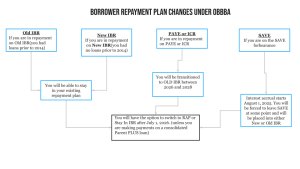
Changes to simplify the repayment process were part of the 2025 One Big Beautiful Bill Act(OBBBA). This includes a new Repayment Assistance Plan(RAP) that some borrowers may find themselves in. The flow chart below can help visualise what this may look like for you.
Summary
Here is a summary of the steps to take:
Step 1: Certify your employment history
Step 2: Ensure you have a qualifying loan type
Step 3: Enroll in a qualifying repayment plan
For the most up to date information you should always visit the www.studentaid.gov website. This should be the first place you check when you have questions and need help with your loans. The most important page is the Public Service Loan Forgiveness program FAQ webpage. The full web link is below and clickable.
https://studentaid.gov/manage-loans/forgiveness-cancellation/public-service#qualify
If your spouse is a teacher, you should know there are specific federal loan forgiveness programs available. Some states also have their own loan forgiveness programs too.
Related Post